

It’s over, folks.
With 99% of the vote in and almost two weeks after the election, John Fetterman (D) notched a decisive victory over Mehmet Oz (R) by nearly 5 percentage points. Depending on how well the remaining provisionals break, we might be able to hit 5 points on the head, but we’d be splitting hairs if it comes to that.
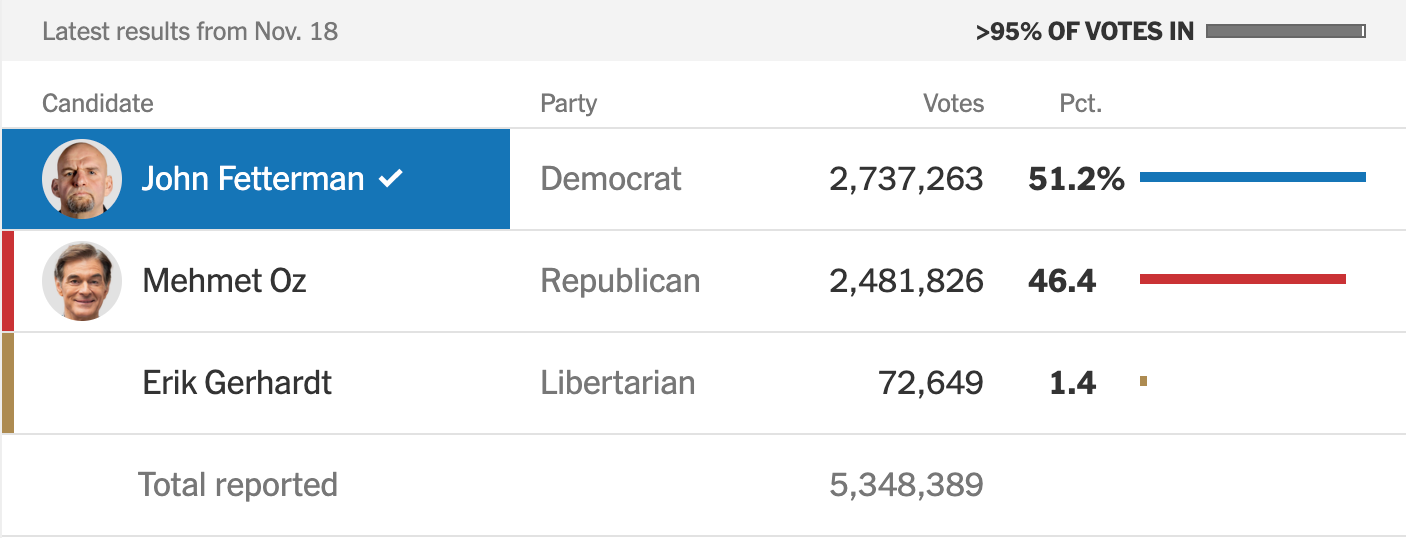
Along with his significant margin of victory, Fetterman performed better than his predecessor, Pat Toomey (R), in both of his election bids in 2010 (51%) and 2016 (48.9%). Additionally, Fetterman is the best-performing Democrat in that seat since 1962, which is an impressive achievement on its own.
That brings us to the main question. Why did Fetterman beat Oz?
Topline
The answer itself is fairly simple. For those of you who read my last few blog posts and tweets on the factors that pointed to him winning, I’ll reiterate them again since they all appear to have come to fruition.
Outperformed in western PA as I thought he would. Not only did he do better than Biden there, he did better than a lot of prior Senate and Presidental candidates save for Bob Casey. Let’s take a look at the pinnacle of western PA counties, Allegheny, as an example of this situation.
Allegheny
McGinty 2016: 55.2% (1.7% loss statewide)
Clinton 2016: 55.9% (0.7% loss statewide)
Casey 2018: 65.7% (13% win statewide)
Biden 2020: 59.6% (1.17% win statewide)
Fetterman 2022: 63% (5% win statewide)
Far better favorables than Oz. Exit polling, post-election interviews, and more, pointed to an electorate that had significant issues with reconciling their vote with a candidate that constantly swam in 50%+ unfavorables. This Guardian piece gives a great peek into the phenomenon of people voting for Oz purely out of logistics, not because they liked him. By contrast, Fetterman supporters were far more enthusiastic about supporting him.
The majority of non-partisan quality polling continued to show Fetterman in the lead all the way to the closing days of the race. The R-leaning junk polls have been heavily discussed at this point, so I imagine most people are aware of them, but when you cut through the noise and look at quality numbers, you wouldn’t be that surprised to see what happened on November 8th.
Great top-of-the-ticket asset in the form of Josh Shapiro. There’s a lot of back and forth on how much coattails he provided, if at all, but you won’t find anyone disagreeing with the notion that he certainly didn’t hurt Fetterman in the slightest. Bonus props to him for breaking into the 3 million voter club!
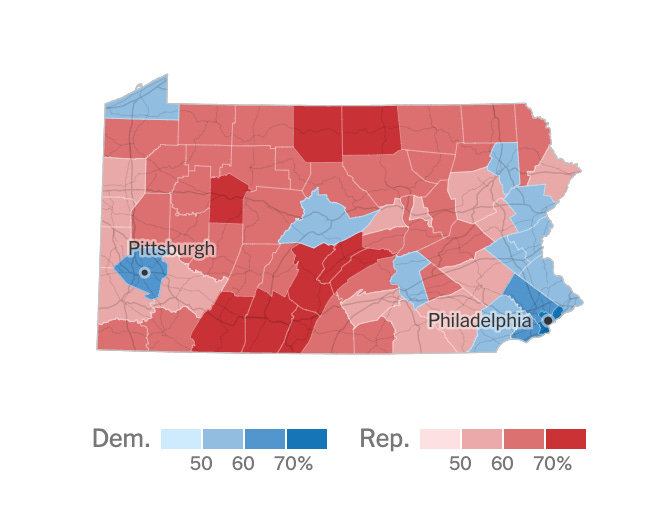
Strong regional advantage. This is somewhat covered in my point earlier about western PA, but although Fetterman outperformed Biden just about everywhere, he did so by the largest margins in western PA. The NYT swing map illustrates that quite clearly.
Parity in money against Oz’s $100+ million deluge of attack ads. Fetterman was able to hold his own and slightly outspend Oz at varying points in the race, owing to his strong grassroots fundraising advantage, help from the DSCC, key third-party groups, etc.
I long said that Oz’s only asset was a redder-than-expected national environment, which, as everyone knows, didn’t quite manifest as the GOP expected. Definitely not in PA and MI, that’s for sure.
County Breakdowns
When all is said and done, some of the raw vote totals out of various PA counties in relation to previous years are surprising and point to some statewide trends that we should make note of for future elections. 2018 was the last midterm and with similar turnout, so how does 2022 chalk up?
Statewide
2018: 5,009,400
2022: 5,348,389 (99% reporting)
Individual county breakdowns below are raw total of Dem votes for the Fetterman/Oz race (2022) in comparison to Bob Casey’s raw totals in his 2018 Senate race.
Allegheny
2018: 355,907
2022: 357,188
Bucks
2018: 165,408
2022: 163,371
Chester
2018: 140,138
2022: 146,552
Dauphin
2018: 59,533
2022: 61,219
Delaware
2018: 163,216
2022: 157,999
Montgomery
2018: 248,454
2022: 257,140
Philadelphia
2018: 481,467
2022: 410,896
Omitted counties are either slightly behind 2018 numbers or don’t have all of their votes in, but are pretty close to or a little above 2018 regardless. With that comes some observations.
The county with the biggest lag in comparison to 2018 is Philly, which I guess is not that surprising to some people. I was fortunate enough to be able to track Philly turnout on Election Day and although they were able to get pretty close to 2018 numbers, turnout in the black wards and minority blocs of the city lagged the most. Based on what we know, this is not an isolated issue across the country - the Dem base didn’t turn out at the usual levels, with this being a more persuasion-focused midterm.
With 2022 having 300K+ more raw votes than 2018 despite lower Philly turnout, Fetterman and Shapiro were able to compensate for that by digging into the rural counties and putting up monster numbers in the Philly collars.
Just about everywhere save for Philly was able to get to 2018 levels and then some. For Fetterman, it’s decidedly impressive to do better than Bob Casey by raw vote in Allegheny alone. Chester too, which, if anyone was watching the mail-in numbers like I was, pointed to some issues for the GOP there. Guess it proved to be correct!
Q & A
Naturally, with a race like this, some questions will be posed regarding some of the situations that played out. My answers to a few of them are as follows.
Q: Did Shapiro carry Fetterman?
A: If this were a much closer race of the 1-point variety, I would likely say yes. But since Fetterman has a robust statewide lead combined with the numbers we were seeing in the early vote and exits, he would’ve been able to win on his own against Oz. However, it probably would’ve been in the 2.5-4 point range. When you’re winning independents by almost 20 and supposedly 10% of Republicans, you’re not being dragged over the finish line by someone else, I promise you that.
Q: Did the debate hurt Fetterman?
A: Not particularly. I still remember what happened on October 25th rather vividly when literally everyone on and off Twitter were freaking out. I pointed out a few things while waiting for calmer heads to prevail.
Some people are skeptical about the fallout not costing Fetterman a few points at least, which is understandable. Post-debate numbers don’t really bear that out across a variety of metrics and I don’t subscribe heavily to that club based on my personal experiences with public interaction to medical issues. Plus, Adam Jentleson did a good writeup about how the stroke and post-debate might have actually helped Fetterman. Check him out if you’re curious.

Q: Could Fetterman have won by more?
A: Sure, though you could say that about any candidate from any party depending on statewide conditions. If you think the stroke cost him, he could have. If it were an even more D-leaning year, definitely. But none of these points hide the fact that he stood on top of the fundamentals that allowed him to eek out a comfortable win.
Shoutouts
Team Fetterman did absolutely fantastic with this campaign. They put their hearts and souls on the line for what they believed in and it paid off massively. On top of that, they flipped a traditional campaign script on its head and used the GOP’s own playbook against them. Upon emerging from the primary, Oz was hit with a deluge of tactics that you would expect to see from GOP campaigns, tactics that ensured he was never able to fully recover from such a bruising primary.
Crudites (shoutout to umichvoter on Twitter for this), Jersey Boy, puppy-killer, and more. Oz had a closet full of skeletons and it was used to devasting effect.
PA Dems crushed it with their organization and GOTV initiatives. Their strong showing and efforts up and down the ballot not only ensured Fetterman/Shapiro’s wins, but the survival and solid performances of congressional and state candidates. This is evident in the fact that Matt Cartwright (PA-8) and Susan Wild (PA-7) sailed through in close races and Chris DeLuzio pulled it off in PA-17.
Young voters, particularly the students at Penn State in Centre County. I was told they were planning to push their voters to vote on Election Day, which caused some skepticism for lots of reasons, but they followed through on their promise/efforts and got the vote out. That spilled over to similar demographics across the state where, as polling indicated, Dems showed up by the suggested margins.
Fetterman himself. You can disagree with his politics and ideology if you want, but it takes serious courage to run in the most high-profile Senate race in the country after suffering a stroke that impaired auditory processing capabilities. And, in the process, he inspired a lot of people like myself to know that personal setbacks and/or disabilities don’t define you or your ability to appeal to lots of different voters. The closed captioning stuff was awesome and is something that other candidates who have similar auditory issues, either temporarily or permanently, should use.
Plus, he has the ability to recover fully. He has it a lot better than, say, me, where I’ll never be able to recover or have a cure for my deafness.
Gold Tier Poll Award
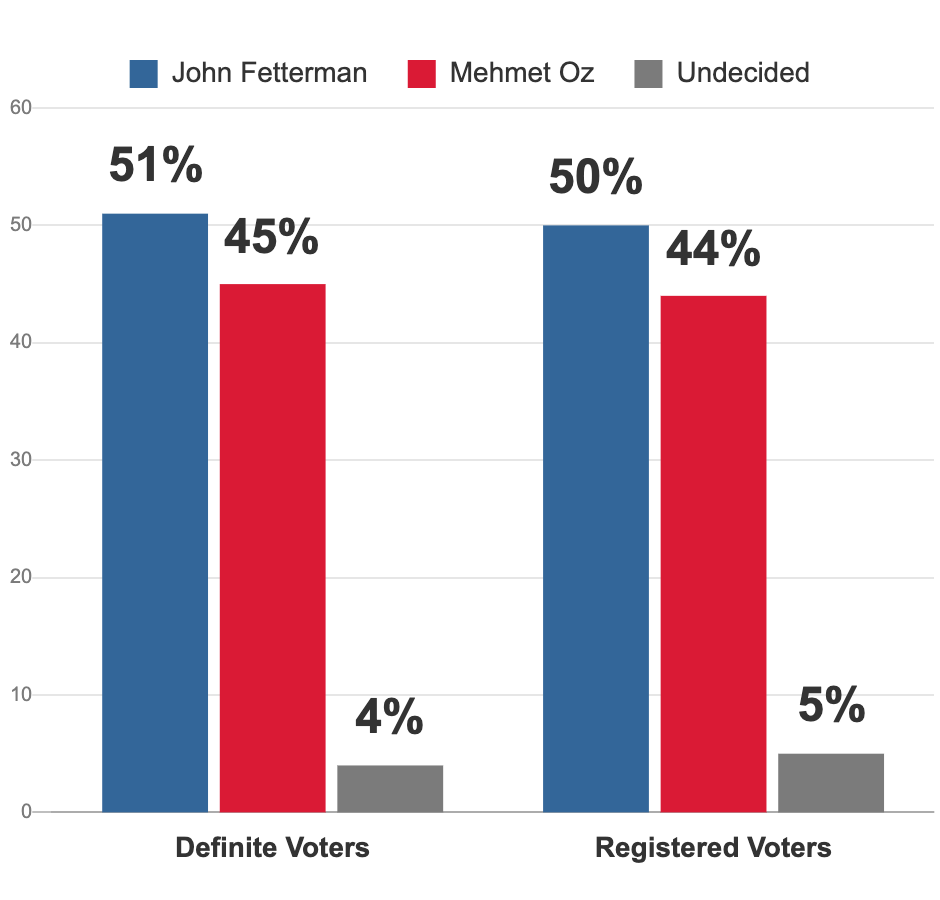
The gold tier polling award of this cycle goes to Marist. Their final Pennsylvania poll before Election Day not only nailed the topline margins for both candidates, but nailed the margins Oz would get on Election Day.
Gold Tier County Award
The award for the best county in the state this year goes to Allegheny. Why?
Monster early vote numbers, dwarfing that of Philadelphia and its collar counties. This county requested the most mail-in ballots out of every county in the state.
Fantastic handling of the mail-in ballots and processing them quickly. Election workers were on the ball here.
Consistent, timely reporting on Election Day. We got nearly complete results from the entire county in a matter of a few hours.
Strong performances in each of the associated congressional districts. PA-12 was an expected win in a relatively safe D seat, but Chris DeLuzio’s performance in PA-17 was decidedly impressive, winning by ~6.5 pts. As long as he takes care of his district, he’ll have a seat there for years to come.
In short, the Board of Elections for the other counties should take a look at Allegheny for a model on what to do.
PA-10
I’m going to pull back from counties for a second and point out one congressional district in particular. No, it’s not Wild’s or Cartwright’s. It’s one that could prove to be a ripe opportunity for PA Dems if Fetterman’s performance there is any indication.
While we’re looking at the state, it would be prudent to note what’s going on in PA-10. A district that encompasses Cumberland and Dauphin counties, Fetterman only lost the former by 5 points (51-46) and won the latter by 10 points (54-44). Dauphin County holds Harrisburg, the state capital, and Cumberland covers some portions of the Harrisburg suburbs.
Dauphin has been getting bluer and bluer over the years as the Harrisburg metro area grows, propelled by a lot of successes by Dems in local elections. I believe the equivalent of the local dogcatcher got 90%+ of the vote here last time, funnily enough. This shift continues to bear out in successive elections and Dauphin will become more and more of an urban Dem center in the future.
Cumberland is also important as well. Bob Casey lost it with 45.7% of the vote in 2018. In comparison, Fetterman actually did a little better with 46% in a worse year. Suburban shifts to Dems are nothing new, but they’re really, really clearly evidenced here.
Scott Perry (R) represents PA-10 with those two counties and won 53-46 this year, 51-49 in 2018. Come sooner or later, most likely the latter half of the decade, he’s really going to start sweating in terms of keeping his seat. So he better hope next decade’s maps draw him into more rural-friendly areas or he’s going to have problems. This needs to be a top Dem target in the next D-friendly midterm.
Takeaways
The hybrid forecasting/analysis model I publically espoused seems to have been prescient. It proved me correct in terms of who would win and by what margins, so I won’t be making major changes to it before the next PA election.
Using the early vote as a part of this is in fact useful. A lot of smart and insightful folks on Twitter pointed out the same, where, by evaluating the composition of mail-in ballots and areas they were coming from and combining them with statistics such as polling and turnout numbers, we could realistically predict what Fetterman/Oz would have to do to win. And, sure enough, those predictions were right on the money. You should never use early vote numbers on their own as a vacuum to indicate anything, but in a hybrid model? There’s some promise there.
In short, much like Bob Casey, Fetterman will have that seat for as long as he wants it, barring a significant red wave or a departure from the characteristics that made him appealing to PA voters. A 5-point win in an even-to-R+3 year is nothing to scoff at, and it’s not even a presidential year.
PA Dems have an incredibly strong bench for years to come. We have no shortage of talent, especially since I only named a few candidates in this post. Casey, Shapiro, Fetterman, Cartwright, DeLuzio, Wild, etc. The list goes on and on. If anyone is worried about running statewide races with unpopular candidates anytime soon, I wouldn’t be.
This glorious map below courtesy of NYT is a sight to behold. You can see how Oz suffered some rural bleeding, as was quite evident early on Election Night. If you want candidates who can put up great numbers statewide by running up the score in the rurals, take a look at Fetterman’s playbook. Every County, Every Vote may be nothing more than a slogan for some people, but it paid off handsomely.
What’s Next?
I thought about it for a while and I will most likely be sticking with Pennsylvania for future elections. My knowledge, contacts, and understanding of the state served me well this year and in the interest of accuracy and being able to do an excellent job with forecasting, it’s best to focus on what I know. I have no idea what voting patterns in Nevada, Georgia, Arizona, etc. are like and wouldn’t be nearly as qualified to comment on these in comparison to other people who are far more plugged into those states than I am. There’s a reason why I said Fetterman would win and by the 3-5 point margin in my first prediction, after all.
Stay safe and I’ll see you all here again in 2024 (hopefully). Cheers!
Great article. Would love to see you talk about other states like Georgia/Texas/Ohio if you feel confident in doing so. Love your writing style.